


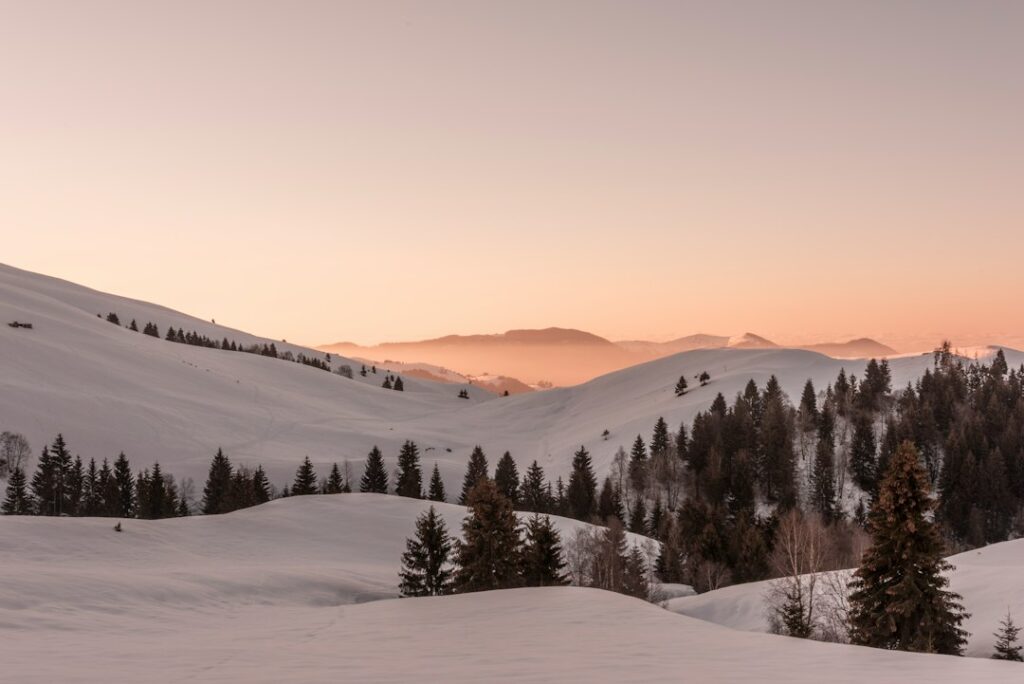
There is no lighting condition more enchanting in outdoor photography than winter golden hour. Because the sun sits at a lower angle throughout the entire winter season, the shadows are long, dramatic, and imbued with cool cobalt hues, while the highlights paint snowdrifts in soft apricot, gold, and rose. Yet balancing extreme dynamic range between glistening snow and dark pine trees requires disciplined technique.
1. Understand How Snow Reflects Low-Angle Light
Unlike grass or soil, fresh powdery snow acts as millions of tiny crystalline prisms. When lit from a low angle, snow reflects directional warmth directly toward your lens, while the reverse side of every ripple and drift casts deep, velvety blue shadows. This natural two-tone palette (warm orange vs. cool cyan) creates instantaneous color harmony.
2. Expose for the Highlights (ETTR with Care)
Once snow highlights clip to pure white (#FFFFFF), there is zero color data left to recover in editing software. To protect delicate sunset gradients:
- Monitor your camera’s RGB histogram closely, specifically the Red and Yellow channels which clip first during golden hour.
- Shoot slightly underexposed if necessary; modern mirrorless and DSLR sensors can easily lift shadow details from snow shadows with minimal noise.
- Use Graduated Neutral Density (GND) filters or bracketing (AEB 3 frames at -1, 0, +1 EV) if shooting directly into the setting sun.
3. Manual White Balance Mastery
Auto White Balance (AWB) is your worst enemy during golden hour snow shoots. The camera algorithm sees excessive orange and tries to neutralize it by adding cold blue, stripping away all warmth. Set your White Balance manually to ‘Daylight’ (5500K) or ‘Cloudy / Shade’ (6500K–7000K) to preserve rich amber sunset tones straight out of camera.
4. Compose with Side-Lighting (Cross-Lighting)
Shooting directly with the sun behind you flattens snow texture into a dull white blanket. Instead, position yourself so the setting sun hits the landscape from a 90-degree angle. This side-lighting accentuates wind-blown snow sastrugi, ski tracks, and ridge lines with three-dimensional depth.